Perhaps the biggest problem with taking your HT bicycling is coming up with a decent antenna on your bicycle. This is because the bike doesn’t provide much of a ground plane. I found an article in the ARRL’s Hints and Kinks written by Charlie Lofgren , W6JJZ, titled “The Bike ‘n Hike Special”. Below are the plans for the antenna for bicycle mobile he described in the article.
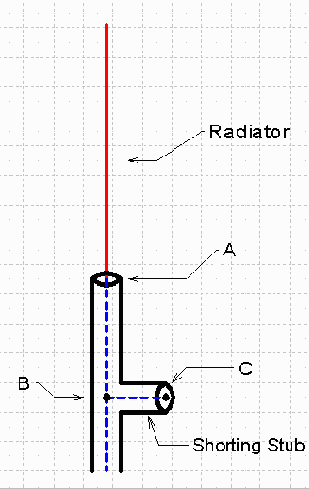
This antenna is a 1/2 wave vertical dipole made out of RG-58/U coax. The beauty of this design is that it is cheap, simple, and easy to make with readily available materials. The radiator should be 39 inches long for 2 meter operation. What I use for the radiator, is the center conductor of the RG-58/U coax. I start out with a 12 foot piece of coax. Then there is enough left so it can be run up to the radio. I keep my radio in my handlebar bag.
First measure how long the radiator is to be, then trim off the outer sheath, and shield. Next, on the other end of the coax, I cut off a piece of coax that is going to be the shorting stub. The proper length is dependent on the velocity factor of the coax used (see table below). In all cases, I always make the lengths to the long side. This way the antenna can be trimmed in to the desired frequency with a SWR bridge.
Short the center conductor to the shield of the coax at point C
The dimensions for the matching section are dependent on the velocity factor of the coax used.
| Dimension | Vel. Factor 0.66 | Vel. Factor 0.80 |
| A to B | 11.25 in | 13.5 in. |
| B to C | 1.63 in. | 2.0 in. |
Why not make a coaxial end fed dipole instead , seams easier?
Well give it a try. I know that an endfed dipole has an impedance of several thousand ohms though. so you would need some sort of matching network for that – which is what everything below the driven element is anyway.